Prompt engineering and prompt writing are two terms that get tossed around interchangeably in AI circles, but they represent fundamentally different skill sets with different goals. If you've spent any time working with ChatGPT or other large language models, you've probably noticed that the quality of your AI response depends almost entirely on what you type into that input box. But here's where things get interesting: are you writing a prompt, or are you engineering one?
The distinction matters more than most people realize. Understanding what prompt engineering actually means is the first step toward getting consistently better outputs. For power users who depend on AI tools daily, knowing which approach to apply (and when) can mean the difference between mediocre results and genuinely useful ones. This article breaks down both disciplines across four clear dimensions so you can sharpen the right skill at the right time.
Key Takeaways
- Prompt writing focuses on clarity and communication; prompt engineering focuses on systematic optimization.
- Engineering requires understanding model behavior, tokenization, and output structure at a technical level.
- Good prompt writing is a prerequisite for effective prompt engineering, not a replacement.
- Power users benefit most when they combine both approaches depending on task complexity.
- Testing and iteration separate casual prompt writing from disciplined prompt engineering workflows.
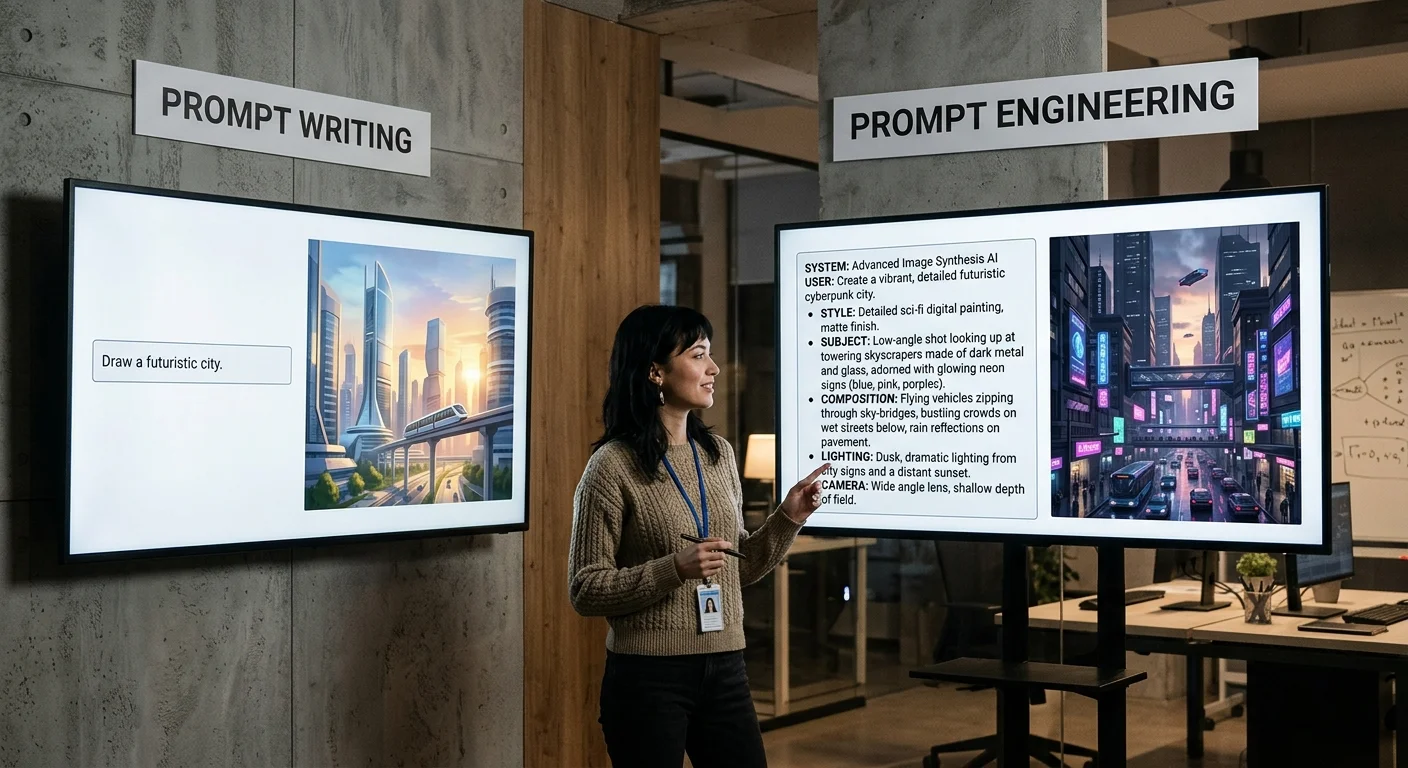
Definition and Scope: What Each Term Actually Means
What Is Prompt Writing?
Prompt writing is the act of composing clear, well-structured instructions for an AI model. It's primarily a communication skill. A good prompt writer knows how to articulate what they want, specify the format they need, and provide enough context for the model to respond accurately. Think of it as the AI equivalent of writing a clear email to a colleague: the better your instructions, the better the result. If you're looking for practical AI prompt writing tips for better outputs, you're already thinking along these lines.
What Is Prompt Engineering?
Prompt engineering goes several layers deeper. It's a technical discipline that involves designing, testing, and optimizing prompts systematically to achieve specific, repeatable outcomes. Engineers don't just write one prompt; they build prompt architectures. They might use techniques like few-shot learning, chain-of-thought reasoning, or role-based framing to steer model behavior. The scope extends beyond individual prompts to entire pipelines, where prompts feed into each other to handle complex tasks that a single instruction could never accomplish.
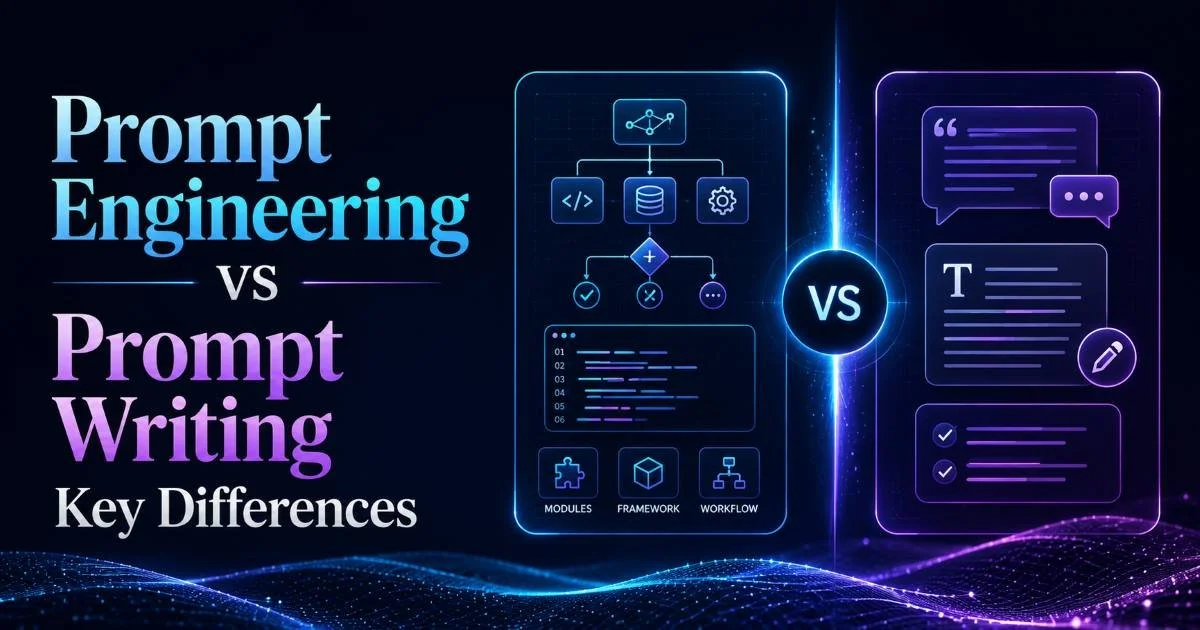
The scope difference is the clearest dividing line. Prompt writing is a single-turn activity: you write something, you get something back. Prompt engineering is multi-turn, iterative, and often programmatic. Engineers consider variables like temperature settings, token limits, system messages, and model-specific quirks. They build reusable templates and test them against edge cases. Writing is one component of engineering, but engineering encompasses an entire methodology around optimization and reliability.
If you find yourself rewriting the same prompt more than three times to get what you want, you've crossed from writing into engineering territory.
Skill Sets and Mindset: Who Does What
The Writer's Toolkit
Strong prompt writers share traits with strong communicators in any field. They think carefully about word choice and sentence structure. They know that vague language produces vague responses, and they understand that prompt clarity directly improves AI response quality. A writer's primary skill is empathy with the model: imagining how the AI might interpret an instruction and preemptively eliminating ambiguity. This is a skill that anyone can develop with practice, even without a technical background.
Writers tend to work intuitively. They rely on natural language instincts, adjusting tone, specificity, and framing based on what feels right. They're often excellent at one-off tasks: drafting a marketing email, summarizing a document, generating creative content. Their work is project-based and situational. A beginner's guide to ChatGPT prompts is essentially a prompt-writing resource, focused on helping people articulate what they need clearly and completely.
The Engineer's Toolkit
Prompt engineers bring a different set of competencies. They understand how language models process tokens, how context windows work, and why the same prompt can produce wildly different outputs with small parameter changes. Many have backgrounds in software development, data science, or computational linguistics. They think in systems, not sentences. Their mindset is closer to a software engineer debugging code than a writer crafting prose. They ask questions like "Why did the model fail on this edge case?" rather than "How can I say this more clearly?"
Engineers also need strong analytical skills. They run A/B tests on prompt variants, measure output quality with rubrics, and document what works for future reference. They build prompt libraries and version-control their templates. This systematic approach is what separates engineering from writing. An engineer might spend hours optimizing a single prompt that will be used thousands of times in a production system, while a writer might spend minutes on a prompt they'll use once.
Process and Methodology: How the Work Gets Done
Writing as Craft
The prompt writing process is relatively straightforward. You identify what you need, compose your request with appropriate context, submit it, and evaluate the response. If the output isn't right, you revise your prompt and try again. Most writers follow an informal feedback loop: write, read, adjust, repeat. The entire cycle might take two or three iterations for a complex request. It's fast, flexible, and well-suited to ad hoc tasks where speed matters more than absolute precision.
Good writers follow established ChatGPT best practices like specifying output format, providing examples, and setting constraints. They might ask the model to "respond as a senior marketing strategist" or "limit the response to 200 words." These techniques work well for everyday use. The limitation is that writing alone doesn't account for why certain approaches work with certain models, or how to handle situations where the same prompt yields inconsistent results across sessions.
"The best prompt writers eventually become prompt engineers, not because writing isn't enough, but because curiosity about why things work leads naturally to systematic optimization."
Engineering as Experimentation
Prompt engineering follows a more rigorous process. It typically begins with defining success criteria: what does a good output look like, and how will you measure it? Engineers then design multiple prompt variants, test them against a dataset or set of scenarios, and compare results. This isn't guesswork; it's structured experimentation. Many engineers use evaluation frameworks that score outputs on dimensions like accuracy, relevance, completeness, and format compliance. The process resembles scientific method more than creative writing.
Read also: How to Run a Website Security Scan for SSL Issues
Engineers also work with system-level prompts, API parameters, and multi-step chains. A single task might involve a system message that sets the model's persona, a user prompt that provides the specific query, and a post-processing step that validates the output. In production environments, prompt engineers build entire workflows where one model's output feeds into another model's input. This level of orchestration is completely outside the scope of prompt writing, and it's where engineering delivers its highest value.
| Dimension | Prompt Writing | Prompt Engineering |
|---|---|---|
| Iteration Cycles | 2 to 3 revisions | 10+ structured variants |
| Testing Method | Manual review of output | Rubric-based evaluation |
| Documentation | Informal or none | Version-controlled templates |
| Tooling | Chat interface only | APIs, playgrounds, evaluation scripts |
| Time Investment | Minutes per prompt | Hours per prompt template |
| Scalability | Single-use focused | Production-grade reusability |
Neither approach is inherently superior. The right choice depends entirely on your use case, frequency of use, and required output consistency.
Outcomes and Use Cases: When to Choose Which
When Writing Wins
Prompt writing is the right approach for the vast majority of daily AI interactions. If you're asking ChatGPT to brainstorm blog post ideas, rewrite an email, explain a concept, or generate a first draft of something, good writing skills are all you need. The overhead of engineering is unjustified when you're dealing with one-off tasks where "good enough" output is perfectly acceptable. Power users who master prompt writing can handle 80% of their AI workflows without ever touching an API or running a systematic test.
Writing also wins when creativity and flexibility matter more than consistency. Exploratory tasks, like asking an AI to generate unusual product names or come up with unconventional solutions to a problem, benefit from the looser, more intuitive approach that writing encourages. Over-engineering these prompts can actually constrain the model's creative range and produce formulaic outputs. Sometimes, a simple, well-phrased question beats a meticulously structured prompt template.
When Engineering Wins
Engineering becomes necessary when the stakes are high, the volume is large, or consistency is non-negotiable. If you're building a customer service chatbot that handles thousands of queries daily, you need engineered prompts that produce reliable outputs regardless of input variation. If you're generating structured data, like extracting specific fields from unstructured text, engineering gives you the control and predictability that writing alone cannot. Any production AI application requires engineering, full stop.
Engineering also wins when you're working with complex reasoning tasks. Multi-step analysis, code generation with specific requirements, and tasks that require the model to maintain context across a long conversation all benefit from engineered approaches like chain-of-thought prompting and explicit reasoning scaffolds. These techniques aren't something you stumble into through intuitive writing; they require deliberate design and testing to implement effectively.
Don't over-engineer simple tasks. Adding chain-of-thought reasoning to a basic summarization request wastes tokens and often produces worse results.
Frequently Asked Questions
?How do I know when to switch from prompt writing to prompt engineering?
?Can strong prompt writing skills replace learning chain-of-thought techniques?
?How long does it realistically take to develop prompt engineering skills?
?Is it a mistake to treat every AI task as a prompt engineering problem?
Final Thoughts
Prompt writing and prompt engineering sit on the same spectrum, but they occupy very different positions. Writing is where everyone starts and where most daily interactions live. Engineering is where you go when you need reliability, scale, and precision. The smartest power users develop both skills and know when to deploy each one.
Start by mastering clear, specific prompt writing. Then, as your needs grow more complex, layer in engineering practices like structured testing, template development, and systematic evaluation. The combination of both skills is what turns an AI tool user into an AI tool master.
Disclaimer: Portions of this content may have been generated using AI tools to enhance clarity and brevity. While reviewed by a human, independent verification is encouraged.