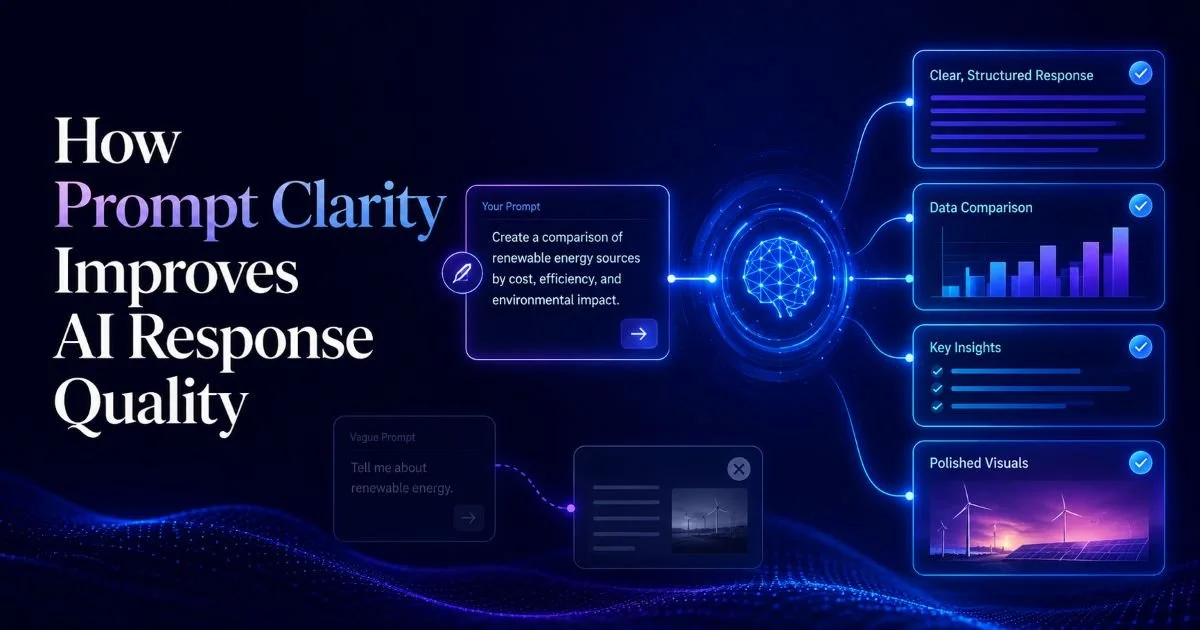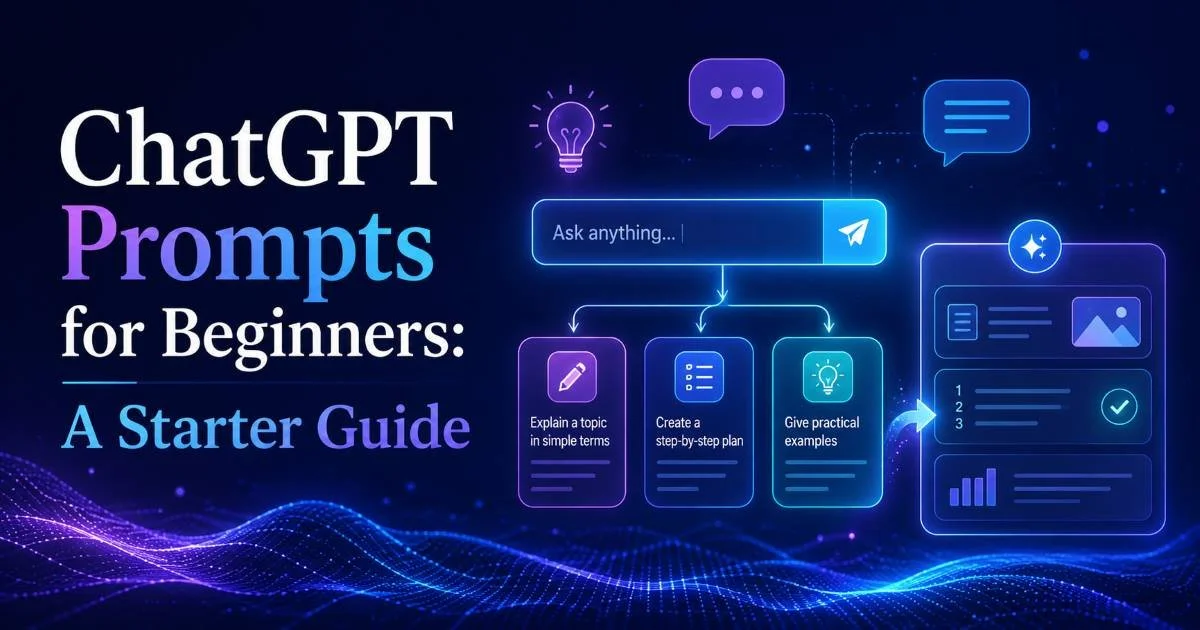
Prompt clarity for AI is the practice of writing instructions for artificial intelligence models with precise language, logical structure, and well-defined intent so that the output you receive is accurate, relevant, and immediately useful. If you've ever fired off a question to ChatGPT and gotten a meandering, vaguely helpful wall of text, the problem almost certainly started with your prompt.
The gap between a mediocre AI response and a genuinely valuable one is rarely about the model itself. It's about what you feed it. For power users who rely on AI tools daily, mastering prompt clarity for AI isn't optional; it's the single highest-return skill you can develop. This article breaks down what that means in practice, how to structure your prompts effectively, and why intent matters more than word count when talking to a language model.
Key Takeaways
- Clear prompts reduce back-and-forth iterations and save measurable time on every task.
- Structure your prompt with role, context, task, and format for consistently better results.
- Ambiguous intent is the top reason AI models produce generic or off-target responses.
- Effective AI prompts specify constraints like word count, audience, and tone upfront.
- Testing and refining prompts systematically outperforms relying on a single "perfect" attempt.
What Is Prompt Clarity and Why Does It Matter?
Prompt clarity for AI refers to how unambiguously your written instruction communicates what you want a model to do. A clear prompt removes guesswork. It tells the AI who it should act as, what context surrounds the task, exactly what output you need, and what format that output should take. When any of these elements is missing or fuzzy, the model fills in the blanks with statistical guesses, and those guesses often miss the mark.
The reason this matters so much comes down to how large language models process input. Models like GPT-4, Claude, and Gemini don't "understand" your request the way a human colleague does. They predict the most probable next tokens based on your input. The more specific and structured your input, the narrower the prediction space, and the more relevant the output. Think of it as giving directions: "head north" is less useful than "take the second left on Oak Street."
For AI tool power users, this has direct productivity implications. A 2023 study by Nielsen Norman Group found that users who refined their prompts got usable results 50% faster than those who accepted first-draft outputs. That time savings compounds across dozens of daily interactions. If you use AI for writing, coding, research, or data analysis, improving your prompt quality is the fastest path to improving your AI output across the board.
The Cost of Vague Prompts
Vague prompts don't just produce bad answers; they waste cycles. Each follow-up clarification means another API call, another wait, and another context window partially consumed by correction. For developers working with the Gemini API or similar services, those extra calls can translate to real costs and rate-limit headaches. Writing it right the first time is cheaper in every sense.
Before sending any prompt, ask yourself: "Could a stranger interpret this differently than I intend?" If yes, rewrite it.
How AI Prompt Structure Works in Practice
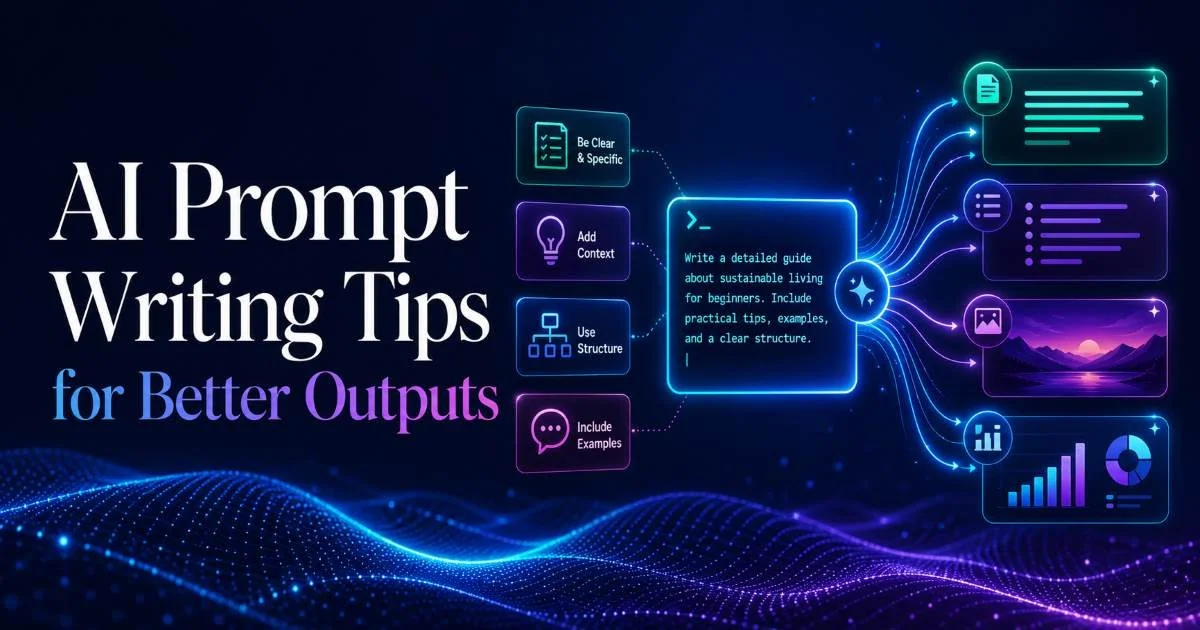
Effective AI prompts follow patterns. While there's no single "correct" template, the best prompt engineering tips converge on a shared set of components. Understanding these components lets you construct prompts that consistently produce high-quality results, regardless of which model you're using. The goal is to minimize ambiguity while giving the model enough context to generate something genuinely useful.
The Four-Part Framework
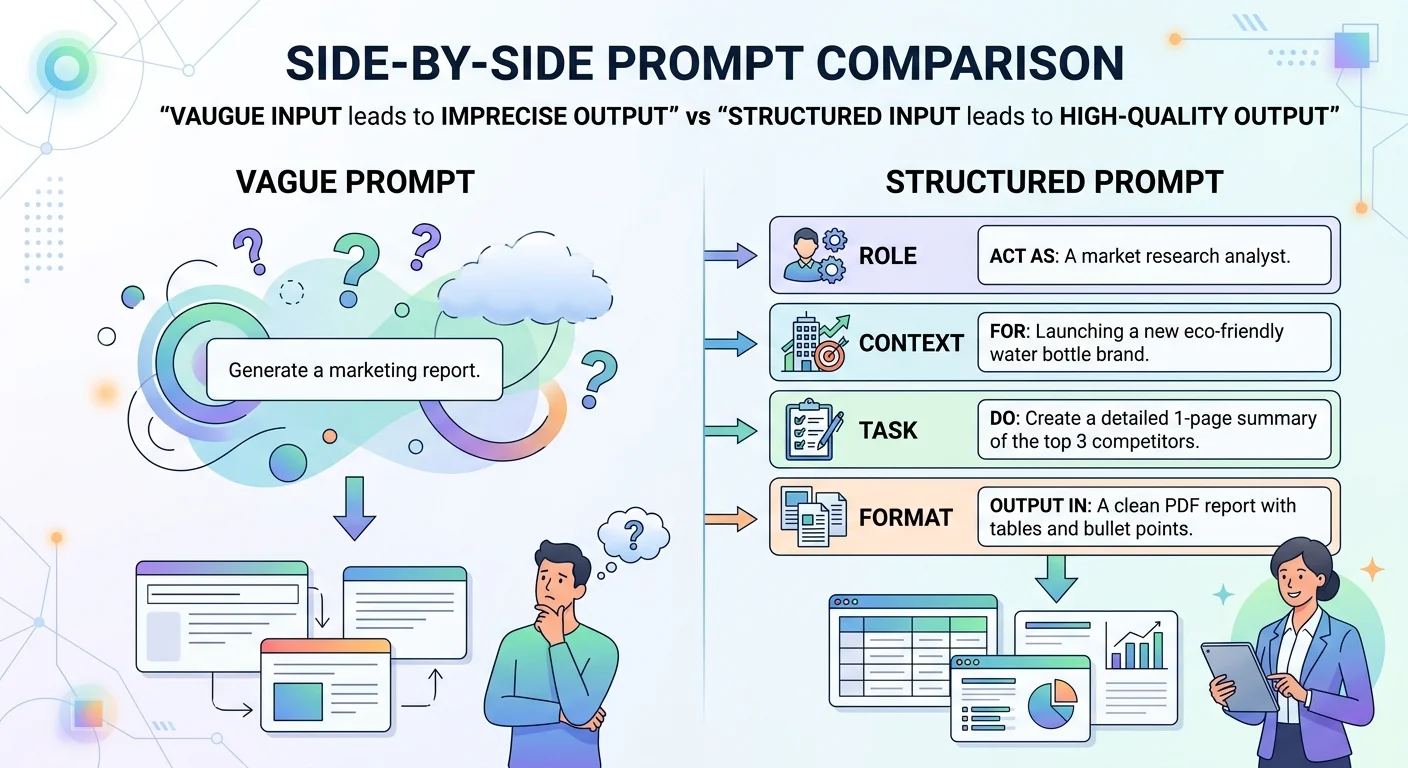
The most widely adopted ai prompt structure breaks down into four parts: Role, Context, Task, and Format. Role defines who the AI should emulate (e.g., "You are a senior data analyst"). Context provides background information that the model needs. The task specifies exactly what you want done. Format tells the model how to present its answer. When all four are present, the model's output quality jumps dramatically.
| Component | Purpose | Example |
|---|---|---|
| Role | Sets expertise level and perspective | "Act as a cybersecurity consultant." |
| Context | Provides the necessary background | "Our company uses AWS and serves 10K users." |
| Task | Defines the specific action | "List the top 5 vulnerabilities to audit" |
| Format | Specifies output shape | "Return as a numbered list with severity ratings." |
Consider ChatGPT prompt writing as an example. A prompt like "Tell me about marketing" will return a generic overview. But "You are a B2B SaaS marketing strategist. Our product is a project management tool for remote teams priced at $15/month. Write five email subject lines for a re-engagement campaign targeting users who churned in the last 90 days." gives the model everything it needs. The output from the second prompt is specific, actionable, and ready to test.
Different models respond slightly differently to the same structure. GPT-4 handles long system prompts well; Claude excels with explicit constraints; Gemini benefits from examples within the prompt.
If you're new to the concept of prompts altogether, a helpful primer on what a prompt actually is can ground your understanding before you start optimizing structure. The fundamentals matter. You can't improve what you don't understand, and many power users skip the basics only to hit a ceiling later.
Common Misconceptions About Prompt Engineering
There's a lot of noise around prompt engineering tips, and some of it is flat-out wrong. The most persistent myth is that longer prompts always produce better results. In reality, length without structure just adds noise. A 500-word prompt full of redundant instructions will confuse a model more than a focused 80-word prompt with clear constraints. Quality of information beats quantity of words every single time.
Myths vs. Reality
Another common misconception: that there exists one "magic prompt" template that works universally. This ignores the fact that different tasks have fundamentally different requirements. A prompt optimized for creative fiction writing would perform poorly for SQL query generation. The skill isn't memorizing templates; it's understanding the principles behind prompt clarity for AI and applying them flexibly to each situation you encounter.
Some users also believe that "prompt engineering" is a passing fad that will become irrelevant as models get smarter. While models are indeed improving at interpreting ambiguous input, the performance gap between a well-crafted prompt and a sloppy one has actually widened with more capable models. GPT-4 does more with good instructions than GPT-3.5 ever could, which means the ceiling for well-prompted output keeps rising. The skill becomes more valuable, not less.
"The performance gap between a well-crafted prompt and a sloppy one has widened with more capable models."
A final myth worth addressing: the idea that prompt optimization is only relevant for text generation. In practice, prompt clarity for AI applies equally to image generation, code completion, data extraction, and agentic workflows. Any system that takes natural language input and produces output benefits from clearer instructions. Whether you're prompting DALL-E, GitHub Copilot, or a custom RAG pipeline, the same principles hold true.
Don't confuse prompt injection (a security concern) with prompt engineering (an optimization practice). They share vocabulary but have very different goals and implications.
Real Examples and Techniques for Better Output
Theory is useful, but examples are where prompt engineering tips become tangible. Let's look at how small changes in prompt construction lead to dramatically different outputs. These are real patterns drawn from production use cases, not hypothetical scenarios. The before-and-after contrast illustrates why structure and intent are the two variables that matter most when you want to improve AI output.
Before and After: Prompt Rewrites
Consider a developer who prompts: "Explain React hooks." The model returns a textbook overview covering useState, useEffect, and custom hooks at a beginner level. Now compare: "You are a senior React developer mentoring a mid-level engineer. Explain the rules of hooks, focusing on common mistakes with useEffect cleanup functions. Include two code examples showing incorrect and corrected implementations." The second version produces targeted, expert-level content because every ambiguity has been resolved upfront.
Another technique that dramatically improves results is providing examples within the prompt itself, a method called few-shot prompting. If you want the AI to write product descriptions in a specific style, include two or three samples of that style in your prompt. The model pattern-matches against your examples and produces output that's far more aligned with your expectations. This works particularly well for ChatGPT prompt writing tasks where tone and voice consistency matter.
Negative constraints are equally powerful. Telling the model what not to do ("Do not include introductory filler. Do not use bullet points. Do not exceed 200 words.") eliminates common failure modes. Most users focus entirely on positive instructions while ignoring the boundaries that prevent the model from drifting. Combining positive task definitions with negative constraints creates a tight corridor that guides the model precisely where you want it to go. Tools like Prompt Analyzer can help you identify gaps in your prompt structure before you send it to a model.
After writing your prompt, try removing every sentence that doesn't add new information. If the meaning stays the same, you've cut noise without losing signal.
Finally, iteration matters more than perfection. The best prompt engineers treat their first attempt as a draft. They review the output, identify where it diverged from their intent, and adjust the prompt accordingly. This feedback loop is where real mastery develops. You start to recognize which types of ambiguity cause which types of failure, and your first drafts get better over time. Effective AI prompts are built through practice, not inspiration.
Frequently Asked Questions
?How do I apply the four-part prompt framework in practice?
?Is Claude or GPT-4 more responsive to structured prompts?
?Do extra API calls from vague prompts actually add up in cost?
?Is assuming a longer prompt always produces better output a mistake?
Final Thoughts
Prompt clarity for AI isn't a hack or a shortcut. It's a communication skill adapted for a new kind of audience: statistical language models that reward precision and punish ambiguity. The four-part framework of Role, Context, Task, and Format gives you a reliable starting point for any interaction.
From there, techniques like few-shot examples, negative constraints, and iterative refinement let you push output quality to levels that vague prompting simply cannot reach. Invest in this skill now, because every future AI model will reward it even more.
Disclaimer: Portions of this content may have been generated using AI tools to enhance clarity and brevity. While reviewed by a human, independent verification is encouraged.